
About
About Appleton Water Softener
Appleton Water Softener installs water softeners, whole-house filter and softener systems, Iron Curtain iron filters and reverse osmosis units for Appleton, Wisconsin homes, and keeps a small library of guides. Most of them start from the same place: city water that the utility has already lime softened, and the question of whether what is left is worth treating. Well owners get their own notes. Throughout, the advice leans on a test of your own tap over any general claim.
What you will find here
Pages are arranged around what people notice at the sink and in the shower. For equipment, start with sizing and setting up a softener, then when to add filter stages in front of it, and how air-injection iron filters work. Each one covers what the system does, how it is sized and what owning it involves.
Five guides go deeper. One explains what the white crust on faucets is. One looks at why lime-softened city water can still leave spots. Others cover softeners and iron, brine tank cleaning and a yearly maintenance plan.
You will not find a contact form. Calling is the only route, and the number sits at the top of each page: 920-678-7902.
Where the water facts come from
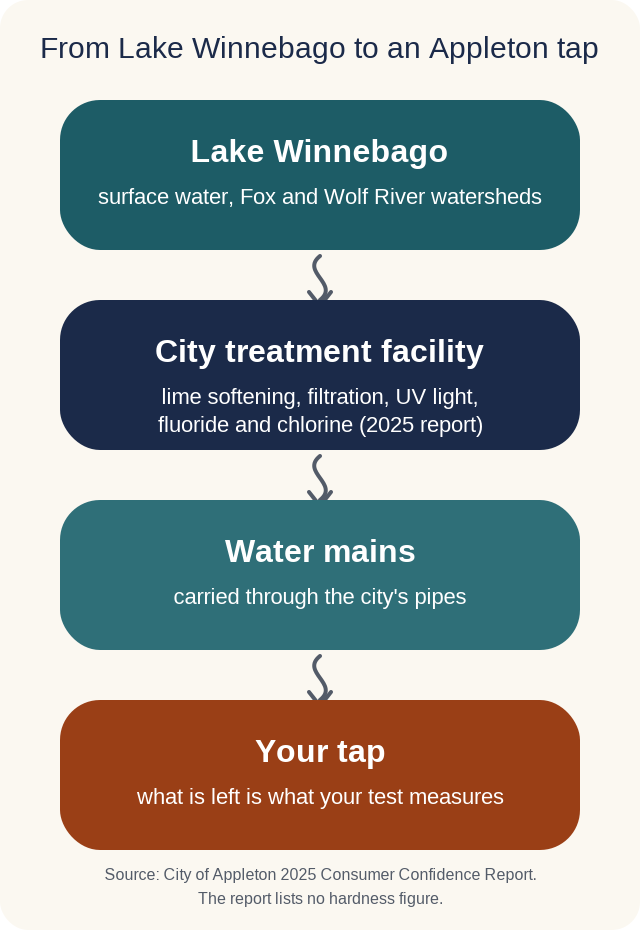
Facts about Appleton's water come from the City of Appleton Water Utility's own Consumer Confidence Reports, the yearly water quality reports every community system publishes. The 2025 report names Lake Winnebago as the source and lists the treatment steps at the city facility: lime softening, filtration, ultraviolet disinfection, fluoride and chlorine. When a page uses one of those facts, it names the report and its year.
General water-treatment guidance comes from university extension services and public health agencies, such as Penn State Extension's 2025 water softening fact sheet and the U.S. Environmental Protection Agency's secondary drinking water standards. Where a guide relies on a manufacturer's manual, it says so and treats the advice as that manufacturer's, not as a rule for every system.

Your test comes first
A test of your own tap beats any citywide average. Every guide explains how to get one.

City water is one case
Pages written for city customers say so. Advice for private wells is labeled separately.

Health testing is separate
Hardness and iron are aesthetic issues. Safety tests for a well go to a certified lab.
About the photos
Pictures across the site show ordinary moments with water: a family filling bottles, laundry being folded, a plate under the tap. Treat them as scene-setting only. Nobody pictured works here or bought anything here, and no photo shows a finished installation.
Diagrams on the site are drawn for it. They explain how equipment works in general terms and carry no local hardness figure, because no dated Appleton figure was found to put on them.
How to get the most from the guides
If you only have a few minutes, start with a test. Hardness strips from a hardware store or a pool supply aisle are cheap and give a result in grains per gallon. Run the cold kitchen tap for a minute first, and make sure the water has not passed through an existing softener or pitcher filter. Write the number down along with the date.
Then match the number to a symptom. A modest result with spotty glasses may point more to dishwasher settings than to a softener. A higher result with scale in a tankless heater makes a stronger case. Orange stains are a separate question that belongs on the iron page, whatever the hardness reads.
Finally, read the upkeep sections before you decide. A softener that is never given salt, or whose settings were never matched to the water, does very little. The maintenance schedule lays out the monthly, seasonal and yearly checks so you can judge whether that routine suits your household.
What we do not publish here
You will not find prices, opening hours, a street address, staff names, customer comments or promises about results here, because none of those were confirmed when these pages were written. What we do state is what we install: water softeners and replacements, whole-house filter and softener systems, Iron Curtain iron filters and reverse osmosis units. Anything else, ask on the phone.
The same goes for numbers. A hardness figure is only useful with its source and the year it was measured. When a dated figure is not available, the page says so and suggests a test rather than borrowing a number from a neighboring utility.
Not sure what your test means?
Read the number out over the phone and talk it over.