
Service
Iron Curtain water filter in Appleton, WI
Orange stains, rust-colored laundry and a metallic taste point to iron. When a lab test confirms dissolved iron, Appleton Water Softener installs Iron Curtain air-injection filters, which cut staining within their working range.
Around Appleton that mostly means private wells. Not every city home needs one: old galvanized or steel plumbing can add some iron to any supply, and a filter at the entry point does not fix the pipes. Below: how this filter works and when another option fits better.
Where Appleton iron comes from
Appleton city water starts as Lake Winnebago surface water and is treated at the city facility before it reaches homes. The utility's 2025 report does not list iron among the contaminants it detected, so we make no claim of an iron problem on city water. If a city home sees rust, the cause is more often its own plumbing or water heater than the supply. A lab test of the water entering the house sorts that out: if it confirms dissolved iron, we install Iron Curtain filters and can talk through whether one fits.
Private wells in the area are different. Groundwater picks up iron and sometimes manganese from the rock and soil it passes through. Iron at levels above the U.S. EPA's secondary standard of 0.3 milligrams per liter tends to stain fixtures and laundry and give water a metallic taste. That standard is about appearance and taste, not health, but it is a useful line for deciding whether treatment is worth it.
How it works
Air injection in plain terms
Dissolved iron is invisible. To filter it out, it first has to be changed into solid particles, a process called oxidation. An air-injection filter does this with oxygen from the air. The tank holds a pocket of air at the top; water passes through that air, the iron oxidizes into tiny rust-colored particles, and a bed of filter media below catches them.
Every few days the filter backwashes. It flushes the trapped iron to a drain and draws in a fresh air pocket. No chemicals are added, which is the main appeal of this design. Other oxidizers, such as chlorine or hydrogen peroxide, are used where iron levels are higher or where bacteria and sulfur odor are part of the picture.
"Iron Curtain" is a product name for an air-injection iron filter, and it is the name many Appleton homeowners search for. The same principle appears in other makers' equipment. What matters most is that the filter suits your lab result.
Choosing equipment
What decides whether an air-injection filter fits
The kind of iron and the rest of the water chemistry matter more than the brand name. A good lab report answers each of these before anyone recommends equipment.
Iron type
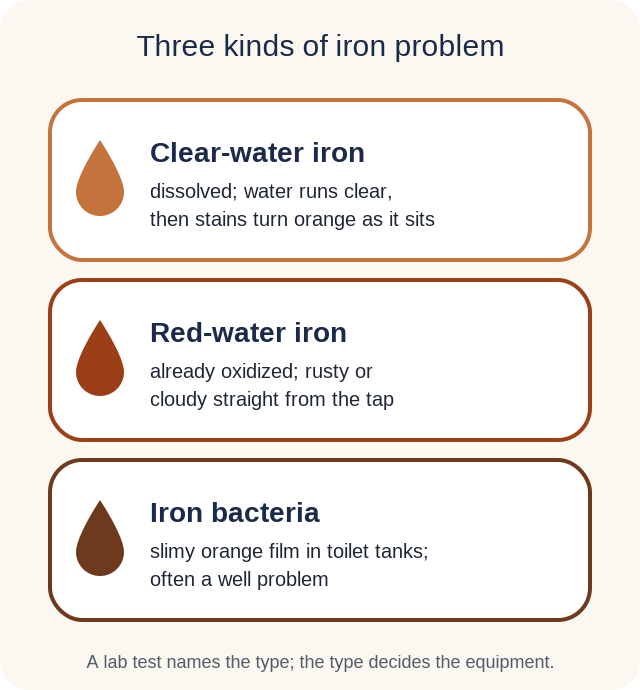
Clear-water (dissolved) iron and red-water iron suit oxidizing filters. Iron bacteria leave slime that can foul media and usually need disinfection as well.
Iron and manganese levels
Every filter has a working range. Very high iron, or manganese alongside it, may call for a stronger oxidizer.
pH
Oxidation works poorly in acidic water. A low pH may need a neutralizer ahead of the iron filter.
Flow and backwash
The well pump must deliver enough flow to backwash the media properly, and there needs to be a drain that can take it.
Where it sits in the line
On a well, the iron filter usually goes after the pressure tank and any sediment filter, and before a softener. Taking iron out first protects the softener's resin from fouling. If hardness is also high, the softener follows and handles what the iron filter leaves.
Some softener makers say their units can handle small amounts of dissolved iron. That works only within narrow limits and with regular resin cleaning, which is why the softener and iron guide recommends treating iron as its own problem.
Living with an iron filter
Air-injection filters need less attention than chemical-feed systems, but they are not set-and-forget. Check that backwash happens on schedule, listen for the air draw, and look at a glass of cold water every month or so. If stains return, retest before changing settings, since well chemistry can shift with the seasons. Media is replaced every several years depending on the load.
Keep a simple log next to the equipment: the date of each lab test, the iron reading and any setting change. Over a year or two that record shows whether the filter is keeping up, and it gives anyone who services the system a head start.


Can iron stains be removed once they form?
Usually, with a cleaner made for rust stains. Avoid chlorine bleach on iron-stained laundry, since it can set the stain.
Do I need a lab test or will a strip do?
Strips give a rough idea. A lab test that names the iron type and checks manganese and pH is far better for choosing equipment.
Seeing orange stains?
Call with your lab results or a description of the stains to talk through whether an Iron Curtain filter fits.