

Service
Water softener installation in Appleton, WI
Appleton Water Softener installs new water softeners and replaces older ones. When your test shows hardness, we install a softener sized to that reading and your daily use. Most homes then see less scale and spotting, though results depend on your water, settings and upkeep.
Appleton city water is already partly softened at the plant, so the size of the job depends on what your own test shows. Below: how sizing works, what a good spot needs and how the first weeks go.
Is a softener the right fix?
A water softener does one job: it removes calcium and magnesium, the minerals that cause scale. If your complaint is white crust, spotty glassware, soap that will not lather or scale in a water heater, a softener addresses the cause. If the complaint is orange stains, a rotten-egg smell, chlorine taste or cloudiness, a softener alone is the wrong tool, and the whole-house filter page or the iron filter page is a better starting point.
For Appleton city customers, the decision often comes down to degree. The utility lime softens Lake Winnebago water before distribution, according to its 2025 water quality report, but it does not publish how hard the finished water is. Some homes find the remaining hardness easy to live with. Others, especially those with tankless water heaters or a lot of glass shower surfaces, want it lower.
Sizing
How a softener is sized
Capacity is measured in grains: how many grains of hardness the resin can hold before it needs to regenerate. The daily load is simple arithmetic. Multiply your hardness in grains per gallon by the gallons your household uses per day. A common planning figure is around 75 gallons per person per day, though your own water bill gives a better number.
The goal is a unit that regenerates every several days, not every night and not once a month. Too small and it regenerates constantly, using more salt and water. Too large and the resin sits for long stretches, and some units then regenerate by the calendar instead of by use, which wastes salt.
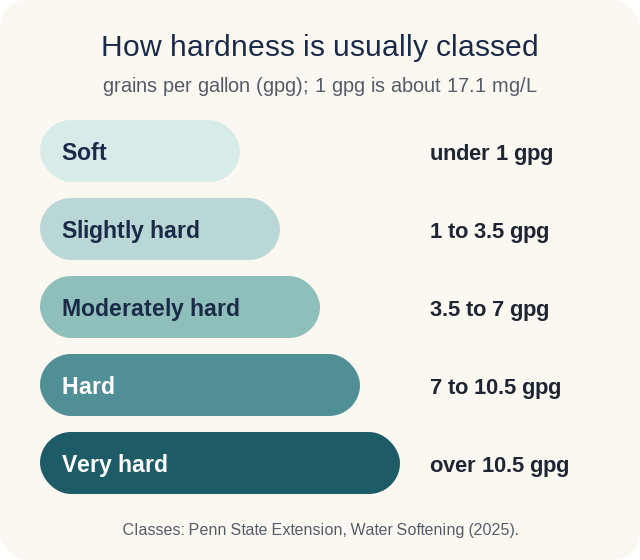
The table shows the arithmetic with a made-up example, not an Appleton figure. Put your own test result in place of the example hardness.
| Step | Hypothetical example |
|---|---|
| Hardness from your test | 8 gpg (example only) |
| People times 75 gallons | 4 people, so 300 gallons a day |
| Daily load | 8 times 300, so 2,400 grains a day |
| Days between regenerations | A 24,000-grain usable capacity lasts about 10 days |
Usable capacity depends on the salt setting. Check the manual for the capacity at the salt dose you plan to use, since higher doses give more capacity but use salt less efficiently.
Placement
What a good installation spot needs
Most Appleton softeners end up in a basement near where the water line enters, before the water heater. The spot matters as much as the unit, because a cramped or awkward location makes salt refills and service harder for years.
Water line and bypass
The softener goes on the main line after the meter and pressure tank, if any, and before the water heater. A bypass valve lets you shut it out for service without losing water to the house.
Outside taps left hard
Lawn spigots usually stay on unsoftened water. There is no reason to spend salt on the garden.
A drain and an air gap
Regeneration sends rinse water to a floor drain or standpipe. The drain line needs an air gap so wastewater cannot siphon back.
Power, space and a dry floor
Most control valves need a standard outlet. Leave room to lift a 40-pound bag into the brine tank, and keep the unit off a floor that floods or freezes.
Local plumbing rules apply to connections and drain lines. Ask us how your installation will meet them, and keep any permit paperwork with the manual.

Setup
Settings that make or break it
A new softener ships with default settings. They need to be changed to match the home before it does good work.
- Hardness. Enter your tested hardness. Add a margin only if the manual tells you to, for example for iron.
- Household size or reserve. Many controllers ask how many people live in the home to keep enough capacity in reserve overnight.
- Regeneration time. Usually set for the early morning when nobody is drawing water.
- Salt dose. Sets the trade-off between capacity and salt efficiency.
The first month
After installation, run a test strip on a hot tap and a cold tap the next day. Both should read close to zero. If the hot tap still reads hard, the water heater may hold untreated water for a few days, so test again after a week.
Watch the salt level over the first few weeks to learn your household's pace, and note the date of each regeneration if the controller shows it. That gives you a baseline. A sudden jump in salt use or a sudden drop to none are both signs that something needs a look, and the maintenance schedule explains what to check.
Expect water to feel different. Softened water rinses soap off more slowly, so many people use less soap and shampoo after a week or two.


Questions about installation
Should the kitchen cold tap be softened?
That is a choice. Some households leave one cold tap unsoftened for drinking and cooking to avoid the added sodium, which rises with the hardness removed. A reverse osmosis faucet is another option.
Does a softener need a permit in Appleton?
Plumbing connection rules vary. Ask us which rules apply to your installation, and keep the paperwork.
How long does a softener last?
It depends on water quality and upkeep. Resin and control valves wear over time; the manual gives the maker's guidance.
Have your test result handy?
Call with the number and the size of your household to talk through a new softener or a replacement.