
Service
Whole-house water filter and softener in Appleton, WI
Appleton Water Softener installs whole-house filter and softener systems: filter stages ahead of a softener, so every tap gets the same treatment. It fits when a test shows grit, chlorine taste or a well odor as well as hardness; each stage reduces only what it is designed to remove.
When hardness is the only issue, a softener on its own is simpler and cheaper to run. When the only complaint is drinking-water taste, a reverse osmosis unit at the kitchen sink is the smaller fix, and we install those too.

Filter and softener are separate jobs
People often use "filter" and "softener" as if they meant the same thing. They do not. A softener exchanges hardness minerals for sodium and leaves most other things alone. A filter physically traps particles or adsorbs compounds onto a medium such as activated carbon. Each can do things the other cannot, and neither treats bacteria by default.
So the first question is what you are trying to fix. Write the symptoms down, then pair them with a test. Hardness strips cover hardness. A basic lab panel can cover iron, manganese, pH and sediment. A smell test at the tap, done with cold water first thing in the morning, tells you a good deal about odor before you spend anything.
Symptom guide
Which stage answers which problem
Use this as a starting map. A test result always overrides it.
| What you notice | Likely stage |
|---|---|
| White crust, spotty glasses, poor lather | Softener |
| Grit in aerators or a toilet tank | Sediment prefilter |
| Chlorine taste or smell on city water | Activated carbon, whole-house or at the kitchen tap |
| Orange or brown stains, metallic taste | Iron filter, chosen by iron type (mostly wells) |
| Rotten-egg smell from a well | Test first; often an oxidizing filter |
| Wanting cleaner drinking water only | Reverse osmosis at one faucet |

Point of entry or point of use?
"Point of entry" means treating all the water where it enters the house. "Point of use" means treating it at one tap, like an under-sink carbon or reverse osmosis unit. If the only concern is how drinking water tastes, point of use is usually enough. Whole-house treatment is for problems that show up in showers, laundry and every fixture, such as hardness, sediment and iron.
Order matters
How the stages are usually lined up
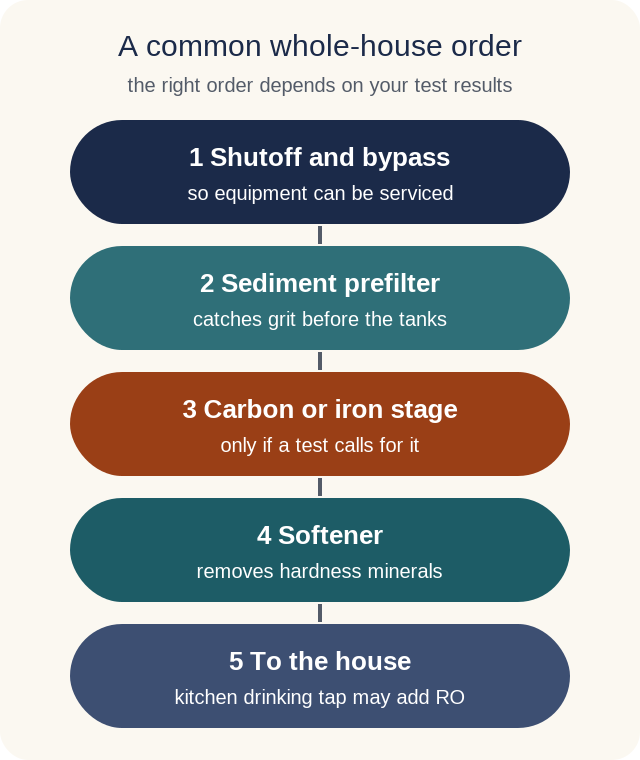
The order protects the more expensive parts. A sediment filter goes first so grit does not foul the softener's resin or valve. A carbon or iron stage, when needed, usually comes next so the softener receives cleaner water. The softener comes last before the water heater and the rest of the house.
There are exceptions. Some iron and manganese setups place the softener first, and some carbon units are designed to sit after it. Follow the maker's diagram for the equipment you choose rather than a general rule.
Every stage adds a bit of pressure drop. Each one has a flow rating, and the total should suit your busiest moment, such as a shower running while the washer fills.
City customers and well owners
For homes on Appleton city water, the source is Lake Winnebago and the city treats it before delivery. A whole-house filter is mainly about preference: catching occasional sediment after main work, or reducing chlorine taste. Many city homes need nothing more than a softener, or nothing at all.
For homes on a private well, the picture changes. Groundwater can carry iron, manganese, sulfur odor and hardness together. A well owner should start with a lab test that covers both safety items (bacteria and nitrate) and aesthetic items (hardness, iron, manganese, pH). The aesthetic results decide the equipment; the safety results decide whether you need something else entirely, such as disinfection.

On city water
Start with a hardness test and a taste check. Add a filter only for a specific complaint.

On a private well
Start with a certified lab test. Equipment follows the results, not the other way around.
Upkeep for a combined system
Each stage has its own schedule. Sediment cartridges are swapped when pressure drops or on the maker's interval. Carbon media is replaced by volume or time. The softener needs salt and an occasional brine tank cleanout. Keeping a dated note on the wall by the equipment is the easiest way to stay on top of it all.

Will a whole-house carbon filter remove fluoride?
Ordinary activated carbon is not designed for fluoride. Reverse osmosis at one tap is the usual route if you want lower fluoride in drinking water.
Do I need UV treatment?
On disinfected city water, generally no. On a well, only if a lab test or a health professional suggests it.
Sort out which stages you need
Call with your test results or a description of the problem to talk through a whole-house system or a softener alone.