
Guide
Hard Water 101: What Causes Those White Spots on Your Faucets?
The short answer: when a drop of water dries on a faucet, the water leaves but its dissolved minerals, mostly calcium carbonate, stay behind as a chalky crust. In Appleton, where the city lime softens its water, how much crust you get depends on what still reaches your tap. If a test shows enough hardness to matter, Appleton Water Softener installs softeners sized to that reading.
What the white crust actually is
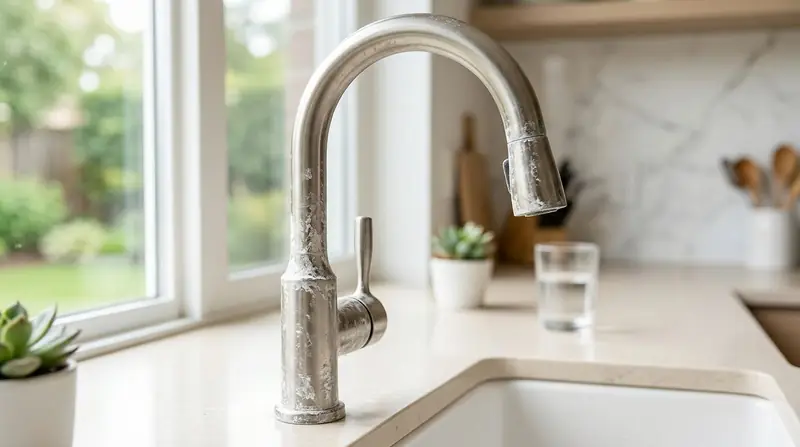
Hard water carries dissolved calcium and magnesium. They do no harm while dissolved, but they come out of solution when water evaporates or is heated. On a faucet the result is a thin white film that thickens with every splash. Around an aerator or a showerhead nozzle it grows into a rough ring that can partly block the flow.
Heat speeds it up. The same minerals settle as scale inside water heaters, kettles, coffee makers and dishwashers, where you cannot see them until performance drops. That is why a crust on the outside of a faucet is worth noticing: it is a visible sample of what is happening inside the hot-water equipment.
A two-minute check
Scale, soap scum or something else?
Not every white mark is hardness. Before you buy anything, try this.
- Soak a paper towel in white vinegar and press it onto the crust for ten minutes.
- Wipe it off. If the deposit softens and wipes away, it is mineral scale. Vinegar dissolves calcium carbonate.
- If it stays greasy or smeared, it is more likely soap scum, a mix of soap and minerals. It is partly a hardness symptom but also a cleaning one.
- If glass stays cloudy after vinegar, the surface may be etched. Etching is permanent damage and a softener will not undo it.
Colored marks are another matter. Orange or brown means iron, which has its own guide. Blue-green suggests corroding copper, which is a plumbing question.
What we know about Appleton's water
Appleton's utility treats Lake Winnebago water at its own facility. The city's 2025 Consumer Confidence Report lists lime softening among the treatment steps, together with filtration, ultraviolet disinfection, fluoride and chlorine. Lime softening raises the pH so that calcium and magnesium drop out as solids at the plant, which lowers hardness before the water enters the mains.
What the report does not give is a hardness figure for the finished water. Neither do the city's reports for 2020 through 2024. So this guide does not give one, and you should be wary of any number that arrives without a source and a year. The useful number is the one from your own tap.
If you are on a private well outside the city system, the lake and the plant do not apply to you at all. Groundwater hardness varies from well to well, and a test is the only way to know.
Testing
How to test your tap properly
Hardness test strips cost a few dollars. To get a reading you can trust:
- Use the cold kitchen tap, and run it for a minute first.
- Make sure the water has not passed through a softener, pitcher filter or refrigerator filter.
- Follow the strip's timing exactly, and read the color in daylight.
- Write down the number, the units and the date.
For a more exact figure, a certified lab can run hardness along with iron and pH. Well owners should use a lab anyway for safety items like bacteria and nitrate.
What to do with the result
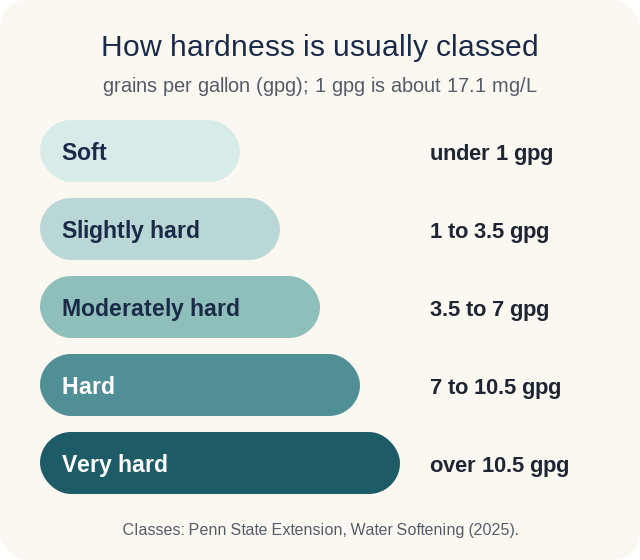
Penn State Extension's 2025 classes put water under 1 gpg as soft, 1 to 3.5 as slightly hard, 3.5 to 7 as moderately hard, 7 to 10.5 as hard and above 10.5 as very hard. Where your tap lands, together with the symptoms you see, points to the next step.
Low reading, few symptoms
Clean with vinegar now and then, use rinse aid, and descale the kettle. No equipment is needed.
Moderate reading
Look at where scale costs you most. A tankless heater or lots of glass may justify a softener; otherwise routine cleaning may do.
High reading or heavy scale
A softener sized from your number is the direct fix, and we install them. See how sizing works.
Keeping faucets clear in the meantime
Wipe faucets dry after use, which stops most spots before they start. Soak aerators and showerheads in vinegar every month or two. For dishwashers, a rinse aid and the right detergent dose make a bigger difference than most people expect.
Is hard water bad for my health?
Hardness minerals are not considered a health risk. The concerns are scale, cleaning and appliance wear.
Why do my glasses spot even after the city softens the water?
Lime softening lowers hardness but does not remove it all. Some hardness remains, and dishwasher heat makes it more visible.
Tested hard, and tired of the crust?
We install water softeners sized to your reading and replace older units that no longer keep up. Expect less scale and spotting, not a promise of none: results depend on your water and settings. A low reading may need nothing at all.